How to Take Better Notes on Readings in College
Heading off to college is kind of similar leveling upward in a video game. In loftier school, the tests and courses were smaller bosses that you lot could take downwardly with low-level equipment. Now that you're in college, you lot're going to need to upgrade some of those items you're taking with you if you lot desire to succeed. This is a whole new risk, my dude.
One of the tools yous accept at your disposal is your notes. Maybe in loftier school you were pretty adept at taking notes, and now you only need to upgrade them a little bit. Mayhap you're feeling similar I did in college, and you've realized you've never properly learned how to take notes.
Never fear! Your guide to taking awesome, constructive notes is finally here. Your days of looking back at what yous scribbled down in class and trying to decipher useful information from them before a examination are over.
In this guide, we'll talk nearly how to fix yourself to have good notes in form, introduce some popular techniques for taking notes, and cover the best ways to go the virtually out of your notes after class.
Prepare Well Before You lot Go to Class
"The most important unmarried factor influencing learning is what the learner already knows" – David Ausubel
Before you even think about heading to class, make sure that you lot've read (or at least skimmed) all pre-assigned reading from your professor. Fifty-fifty if y'all don't have assigned reading, try and familiarize yourself with the topic earlier you become to class and so you know what to expect.
A 2004 study past Spies and Wilkin plant that the law students who were responsible for reading a legal case before they got to grade displayed a greater agreement of the learning materials than students who were not expected to ready before grade.
As well, don't forget to pack all the things you need to learn effectively. Make sure you have multiple pencils (or some backup lead), a notebook, pens, highlighters, sticky notes, your textbook, and your laptop.
Don't forget water! It'southward tempting to bring coffee or some other form of caffeine to class. Attempt to stick to water and consume caffeine intelligently. While coffee doesn't dehydrate you, and coffee in moderation certainly helps y'all focus and stay alarm, caffeine dependency interferes with your quality of sleep and impairs mental function, ultimately impacting your ability to pay attention during class.
Lastly, grab a snack earlier you head out the door for class. Avoid high-salt or high-sugar options, and aim for a "complete snack" that includes fatty, protein, and carbs.
Apples and peanut butter, crackers and cheese, or even certain power bars are good options. These snacks will leave you lot feeling full for longer, ensuring that you won't be distracted by how much yous want a burrito in the middle of your professor's lecture about the construction of a cell.
The Annotation-Taking Mindset
The other affair you should get in order before coming to form is your brain. I know that when I'grand in a good mood and have a positive attitude, I'm way more probable to learn.
I detest math. I suck at math. I'thou like, the worst math student ever. I failed my high-school algebra courses three times. That's how bad at math I am!
When I got to college, my college-level algebra course was the one thing property me back from actually finishing my acquaintance'due south caste. I decided that I was going to pass the class.
So, I showed up every day with a (more or less) positive mental attitude, fabricated an effort to make friends with a classmate I could report with, and paid attention to the lecture, working out bug myself equally we went along.
In the finish, I may not have gotten an A in the class, but I did get a B…which was the highest math score I had gotten since elementary schoolhouse.
Moral of the story? Attitude is everything.
Quick tip: If you notice during grade that your professor has mentioned the same fact twice or more, or has repeated a fact that was talked about in the previous lecture, make a note to yourself. Circumvolve it, underline it, something to tell your brain to pay attention. It'due south definitely going to exist of import later. Keep an heart out for repetition.
The 6 Best Note-Taking Systems
Now that you're set to take notes, let's talk about some pop note-taking techniques. Anybody has a slightly unlike way that they acquire, and certain subjects lend themselves to different styles.
Don't be afraid to experiment with dissimilar techniques to find i that'southward right for y'all!
Structured: The Outline
This is for people who similar simplicity. It'south one of the easiest ways to accept notes, and information technology comes pretty naturally to virtually people.
When taking your outline notes, get-go by choosing 4 or 5 key points that will be covered in your lecture. Below those points write some more in-depth sub-points nigh each topic every bit the professor covers them.
If yous're taking outline notes by mitt, be sure to leave enough space on each page so that yous have plenty of room for all your sub-points. Or, you can accept them on a computer and simply rearrange them equally you become in your text document.
This is a cracking, elementary approach to taking notes. It'll help you follow along and pay attention during class, but information technology can exist overwhelming to review these notes afterward.
To aid in reviewing these kinds of notes, try to read each chief point and summarize information technology yourself without looking too much at your notes. Use your notes to test yourself on how much you actually know rather than only rereading them over and over.
For Review: The Cornell Method
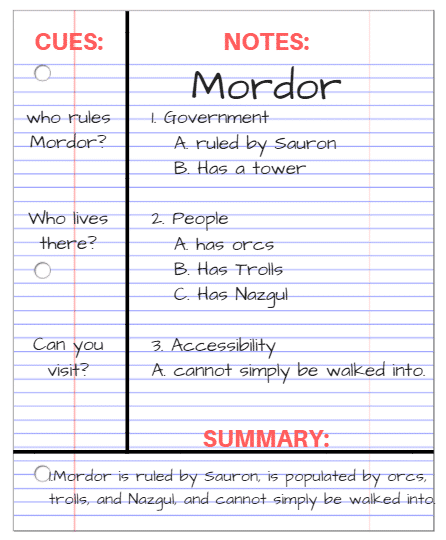
The Cornell Method is a pretty expert way of dividing up your notes if you're looking to go the most out of your review time.
In this method, yous divide your paper into three sections: notes, cues, and summary.
Your notes section is for the notes you lot take during class. You can construction them even so y'all like, but near people like to apply the outline method.
Write your cues section either during or directly subsequently form. This department can be filled out with main points, people, or potential test questions. Use this department to requite yourself cues to assist you remember larger ideas.
You tin can write your summary section directly later form, or afterward when y'all're reviewing your notes. Use this department to summarize the unabridged lecture.
Keep your cue and summary sections every bit elementary as possible. Still, experience free to fill up the notes section with doodles, diagrams, page references, and whatever else you demand to properly stand for the textile presented in form.
In-Depth: The Mind Map
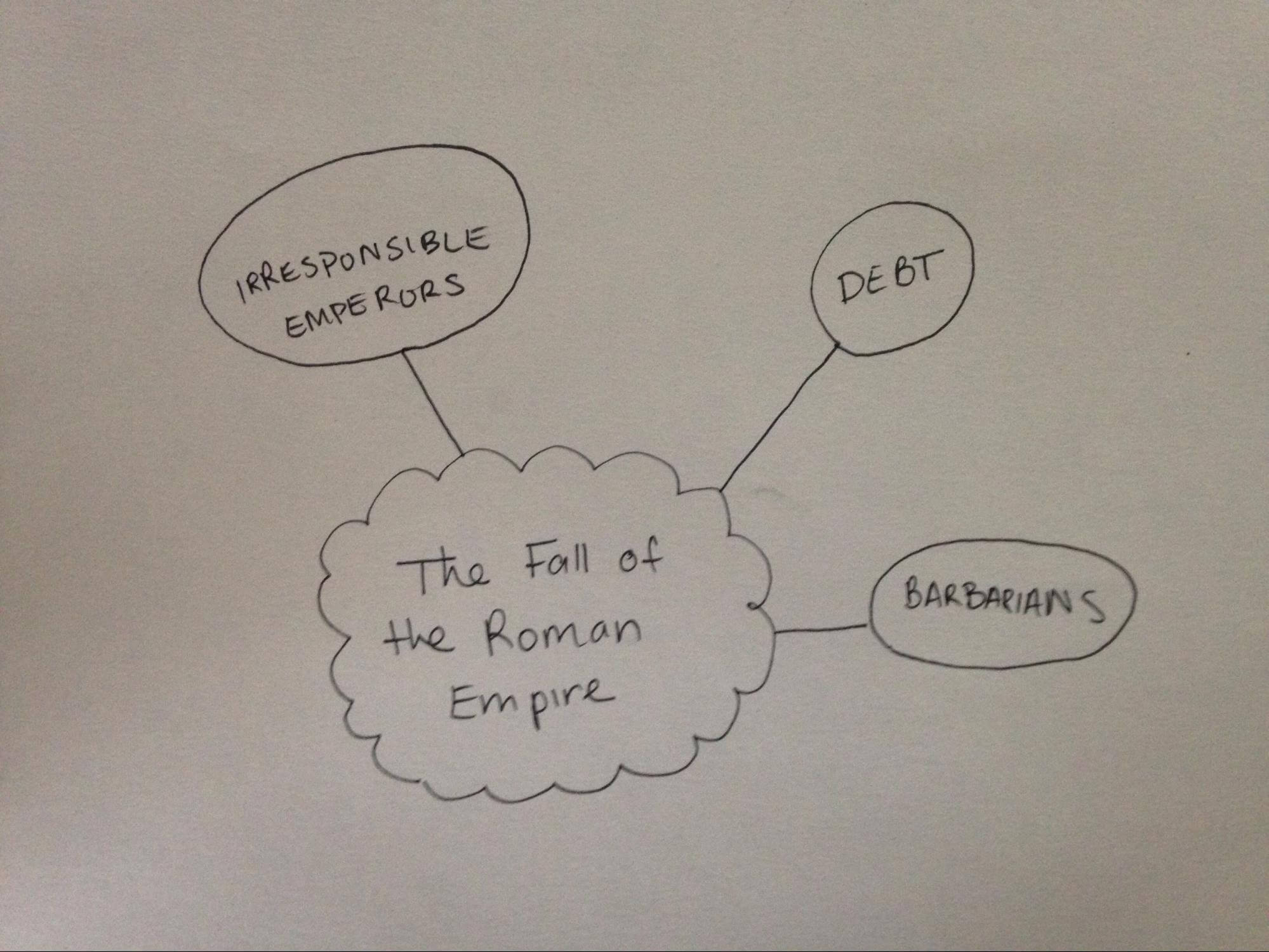
The mind map is a corking manner of taking notes for specific types of subjects. Class subjects like chemistry, history, and philosophy that accept interlocking topics or complex, abstract ideas are perfect for this method. Apply the listen map to become a handle on how certain topics relate, or to go in-depth with ane particular thought.
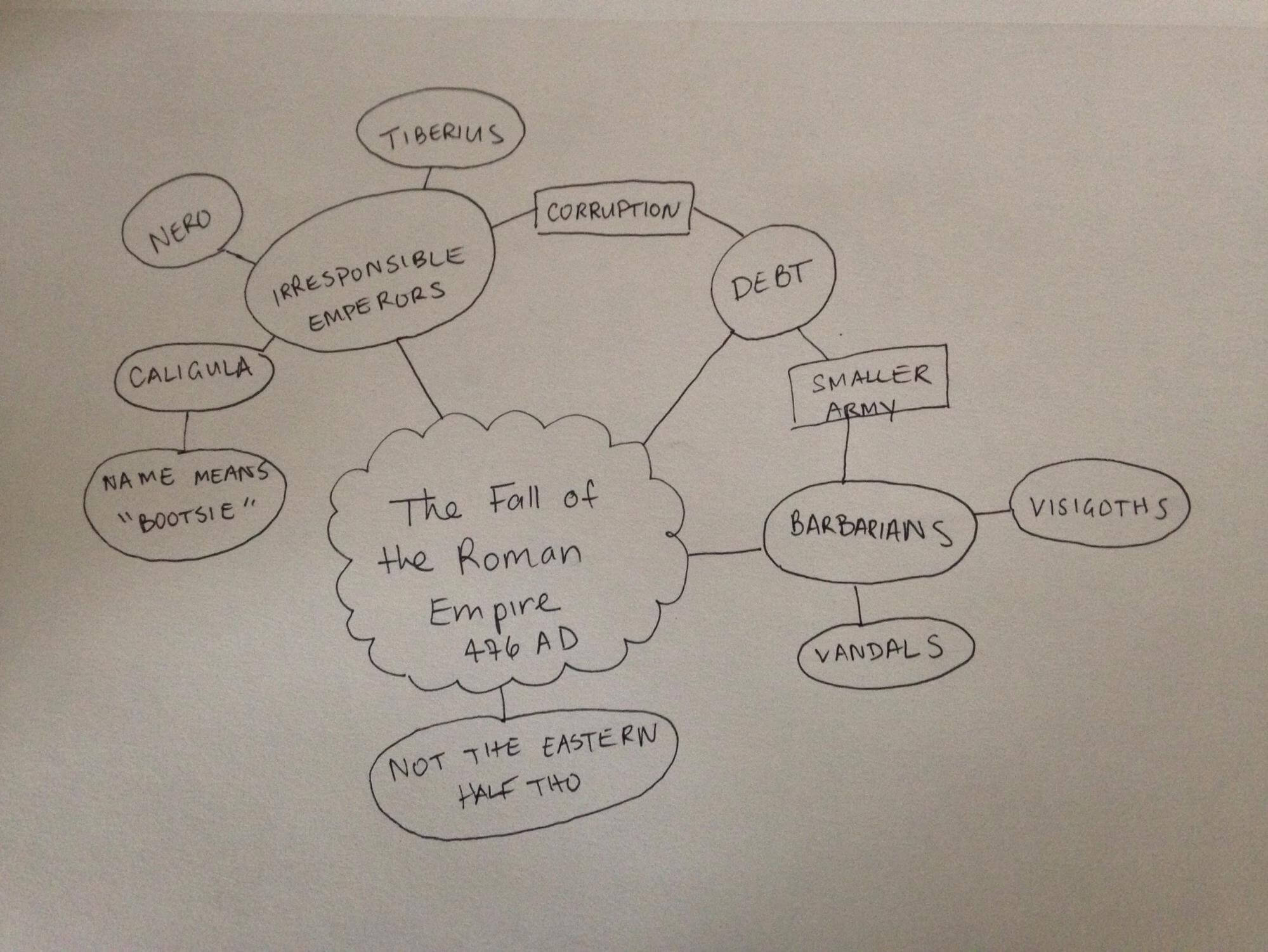
For example, if you're attending a lecture about the Fall of the Roman Empire, start with that concept in the center and then depict "nodes" of all the things that led to Rome's fall every bit your professor lists them. Things like debt, irresponsible emperors, attacks from the surrounding barbaric tribes, and and then on.
Afterward, to review, go more in-depth and add smaller sub-concepts onto each co-operative. Things like dates, formulas, supporting facts, and related concepts make for great branches. In the stop, it might wait something like this:
Holistic: Flow Notes
This notation-taking method is bang-up for students looking to maximize their agile learning within the classroom and minimize their review time afterward. The point of flow notes is to care for yourself like the student you are, and non a lecture-transcribing auto.
Jot down topics, draw arrows, make piddling doodles and diagrams and graphs. Go crazy. Engage with the material. Try to actively learn as you're writing.
Perhaps you're in history class and your professor is talking near the Boxing of Hastings, and y'all recollect that it happened in 1066 and that there were other things happening across the globe in the year 1066, too. Write those facts down and draw connections.
The sky'due south the limit on this one. It's great for people who hate rules.
Caution: while this method is great for learning in the moment, it tin can be hard to review flow notes later on. If y'all're an auditory and visual learner and retain a lot of what you learn from your lectures, maybe that works fine for yous. If not, effort pairing your period notes with the Cornell Method to brand them easier to review for tests.
Easy: Writing on Slides
Permit's exist honest, this is note-taking for lazy people…and there'southward nothing wrong with that!
Information technology's super constructive, and it's like shooting fish in a barrel.
If your professor is kind enough to provide you with the slides that they're using in their lectures, go ahead and download the files and print them out at the figurer lab. The slides requite you a leg upward on the outlining process. The professor already did the work for you! All you have to do is take notes and expand on key concepts already presented in the slides.
It works great, too, because subsequently you can expect at the slide and more or less remember what the professor was talking about when they reached that slide. It'due south like having a step-by-footstep walkthrough of the lecture, and you lot hardly had to do a thing to get it!
Visual: Bullet Journaling
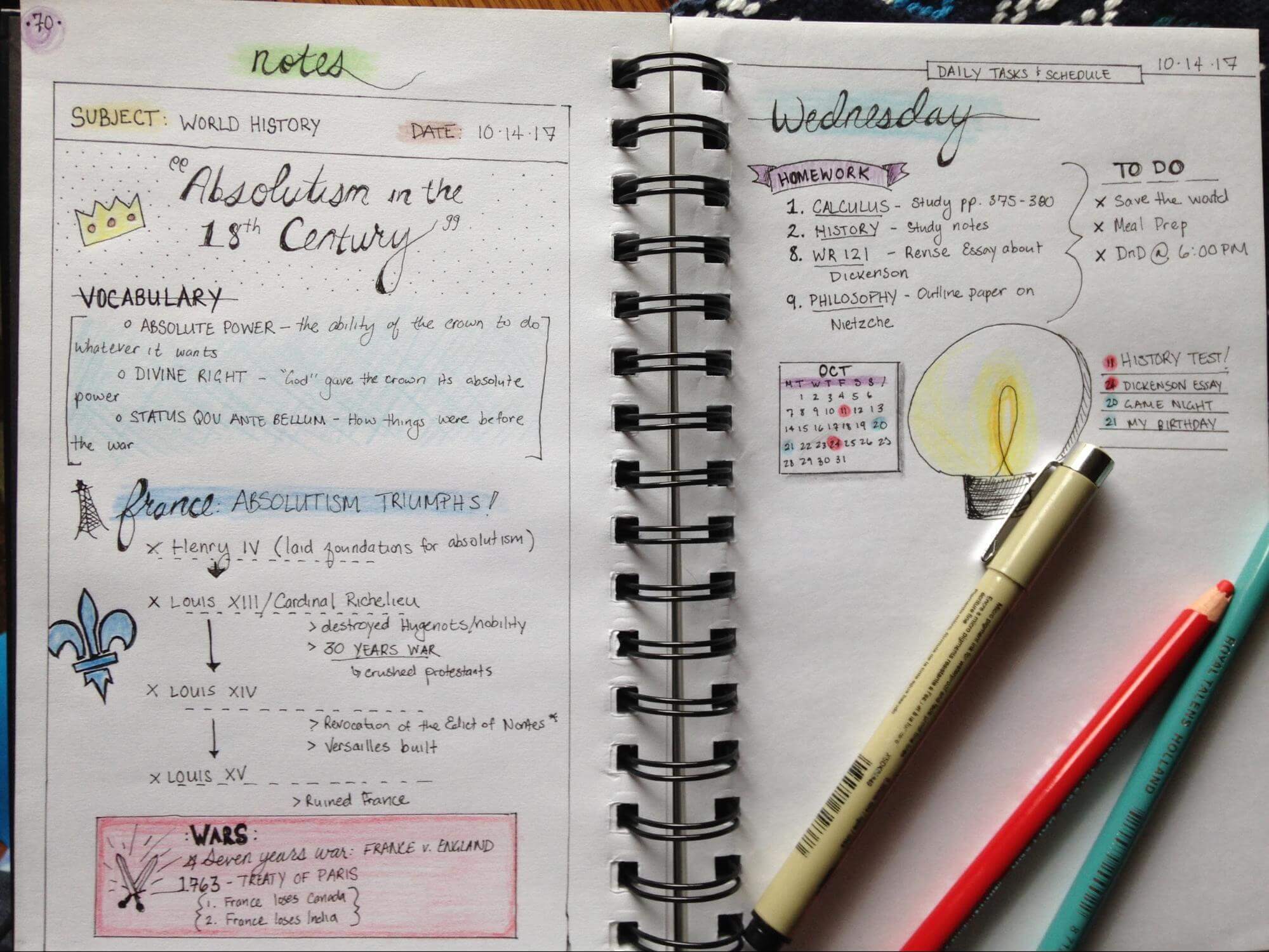
This is my personal favorite. Information technology'south the note-taking mode I use most often, both in and out of the classroom.
If you're super into aesthetics, like to doodle, or are a specially visual learner, this method might be all-time for you.
When you write in your bullet journal, you lot turn a blank page into a beautiful representation of your thought process. Try using information technology to combine unlike aspects of other note-taking styles.
You can have ane page that's dedicated to mind maps, some other that'southward dedicated to your flow notes, and fifty-fifty sneak in a course schedule or a putter of Sonic the Hedgehog in somewhere. It'south your bullet journal. I don't know, do what y'all want! Information technology'south your periodical!
This method does take drawbacks. Information technology can be hard to take notes quickly. The goal of bullet journaling is to keep your journal organized and attractive, which tin can be hard when y'all're scribbling down information as fast every bit yous can.
One fashion to combat this is to take notes during class in an outline or using some other method, and so organize them after in your bullet journal equally a form of review.
Demand ideas for what your periodical should wait like? But go along Pinterest or google 'BuJo ideas', or, specifically, 'BuJo ideas for students', and knock yourself out. There's tons of stuff out at that place!
Should You Use Your Computer to Take Notes?
So, should you lot use your laptop to take notes, or write them longhand? Students, scientists, and teachers take been debating this e'er since laptops were immune into classrooms. The curt respond? No.
The longer reply is a bit more complicated.
In a study published in 2014, students who took notes on a laptop were more likely to simply re-create down what their professor said verbatim.
This actually dumb their learning because their brains were processing the information shallowly, instead of taking larger concepts and condensing them into note-form. These students performed poorly on conceptual tests compared to others who took notes longhand.
Not only that, but some other study published in 2010 showed that most students who take their laptops to class are only working on class-related fabric about 58% of the time.
The other 42% is taken up by going online, working on unlike assignments, or playing Infinite Invaders. These students were more likely to fall off task and were less satisfied with their teaching when asked about it.
The studies concur: using laptops to take notes in class might not be the best selection.
How Yous Use Your Computer Matters!
Of course, it all depends on how you use your estimator. If you lot're a self-disciplined person, y'all might benefit from having your laptop to take verbatim notes you can written report extensively later.
One history class I took in college was really improve considering we had access to our laptops, and could quickly check facts for our professor. They were put to skillful use during discussion times, since students could practise a tiny fleck of googling before they contributed their thoughts.
In short: it's upwards to you lot what tool you utilise to accept notes. Yous're responsible for your educational activity. Just make sure that the tool you're using is a tool, and not a distraction. If you detect yourself nipping out of your note-taking document to play Sims three or scroll through your Facebook feed, perchance switch to taking longhand notes.
Looking for a great app to have and organize your notes? Nosotros recommend Notion:
Notion - All-in-One Workspace
Notion is one of the most flexible and powerful apps I've always used. It can exist a note-taking app, but there's also a database characteristic with multiple views (including Trello-style kanban boards and calendars) the power to brand anything into a template, and great collaboration features. At CIG, we use it for all of our squad documentation, and I also manage every YouTube video I brand with it.
We earn a committee if yous click this link and make a purchase at no additional toll to yous.
The Best of Both Worlds
Prefer writing by hand, simply still desire to be able to access your notes on your computer and are tired of buying notebooks just so y'all can throw them away afterwards? There'due south a solution for that.
Rocketbooks are a super cool slice of new note-taking technology. The notebook is completely reusable. Only take your notes, scan them using your phone and the Rocketbook app, and then, depending on which notebook y'all have, wipe it make clean with a clammy material to re-employ it about indefinitely.
If yous're using the Rocketbook Wave, you tin can just throw it in the microwave and nuke it up to three times. Voila! Yous've got a reusable notebook, and digital notes that you didn't have to take using a tablet and stylus or type out on your laptop.
Desire to learn more about the Rocketbook? Check out our total review.
I'd never heard of these before researching this commodity, and let me tell you lot, they sound like a cracking pick for students looking to lighten their backpack load. They're good for the environment, and they'll save yous some money and infinite since you're not ownership a new notebook every single term.
Demand help keeping your notes (and life) organized? Check out our guide to staying organized in college.
Become the Most Out of Your Notes

Phew! How are you doing? Good? That was a lot. Here's one last thing:
Now that you've got your notes and class is over, how do you go the most out of them? There are three corking ways to maximize your notes:
- Review, review, review. Make sure that you review your notes within the first 24 hours afterwards your lecture. This cements everything y'all heard and learned in your brain so it won't fall out of your head later.
- Review a pocket-sized portion of your notes every solar day. Don't try to cram before your test. Reviewing over a long period time ensures that what you've learned will stick, and improve your recollect.
- As yous're doing assigned reading or research, have your notes on hand and observe repetition. If your professor covered it in class and information technology's in your assigned reading, there'south a good chance information technology'll be on the test.
Ultimately, we could talk about notes and note-taking techniques all day. Only the most of import thing to empathize is that note-taking is a skill. Everyone's encephalon works a petty differently, and what might work for me won't necessarily work for you. Take notes ofttimes, experiment, and find out what you like.
Y'all made information technology to the end! At present, it'southward upwardly to you lot. Commit to the process, pay attention in class, and don't forget to review. You lot've got this, dude.
Want to take notes by hand without sacrificing the convenience of digital organization? Check out our guide to the best annotation-taking apps for iPad.
Image Credits: woman taking notes, girl walking, student writing, layout of chapeau and pens, typing, distracted on phone, studying in library
Source: https://collegeinfogeek.com/how-to-take-notes-in-college/
0 Response to "How to Take Better Notes on Readings in College"
Post a Comment