Why Did the Indians Bury a Baby Upside Down

Photo past Chris Parfitt
Although you may think of 'Native Americans' every bit one people, historically there was never a unified group of 'Native Americans'. Today there are 562 different tribes recognised by the USA, though there is probable to have been hundreds, if not thousands more than throughout the history of the continent. This means that Native American death rituals are widely varied co-ordinate to different tribal traditions, though they may share some mutual beliefs.
Native American beliefs most death
There is non actually such a matter as an organised Native American religion in the mode that Christianity or Islam is a religion. There is no central gear up of rules or beliefs and historically spiritual teachings were never written down, only passed on from generation to generation. Native American behavior are deeply rooted in their cultures and histories, and in the past spirituality would have been an integral part of daily life.
Every bit previously mentioned, each tribe has its ain specific traditions regarding decease rituals and funerals. One common aspect is the idea that the spirit of a person lives on after their physical death and journeys into the afterlife, although there is no concept of heaven and hell.
 Illustration of the funeral scaffold of a Sioux chief. Spiritual practices were a function of daily life, including those involving expiry.
Some tribes in the Massachusetts and Rhode Isle expanse believed that the afterlife lay to the southwest, where a village of ancestors would welcome the souls of the expressionless.
Some tribes believed that advice with the spirits of the decease was possible, and that spirits could travel to and from the afterlife to visit the living. Communication with the dead involved its own special rituals and ceremonies.
Reincarnation, where the soul is reborn into a new body, was as well a mutual belief among some tribes. Wise elders would examine newborn babies to endeavor to effigy out who or what they were in a previous life.
Decease rituals and funeral customs
Many Native American decease rituals are focused on providing the spirit with the things it needs to go far safely at its destination. Many different tribes would leave offerings of food, jewellery, tools and weapons for the spirit; all valuable items in the afterlife. In the past some tribes would even sacrifice slaves and horses in laurels of the person who had died.
Other rituals were focused on trying to safely guide the spirit to its home in the afterlife. Some tribes would get out the body to naturally decompose in a tree or on a funeral platform, or by leaving an opening in the burial bedchamber so the spirit could escape. The natural decomposition also reflects the Native Americans' deep connexion with nature and the cycle of life and expiry.
Frequently the death of a child would have its own specific rituals. In the Ojibwa or Chippewa tribes, a doll would be made from the dead child'southward hair. The female parent would carry it with her for a year, symbolising the grief she is carrying.
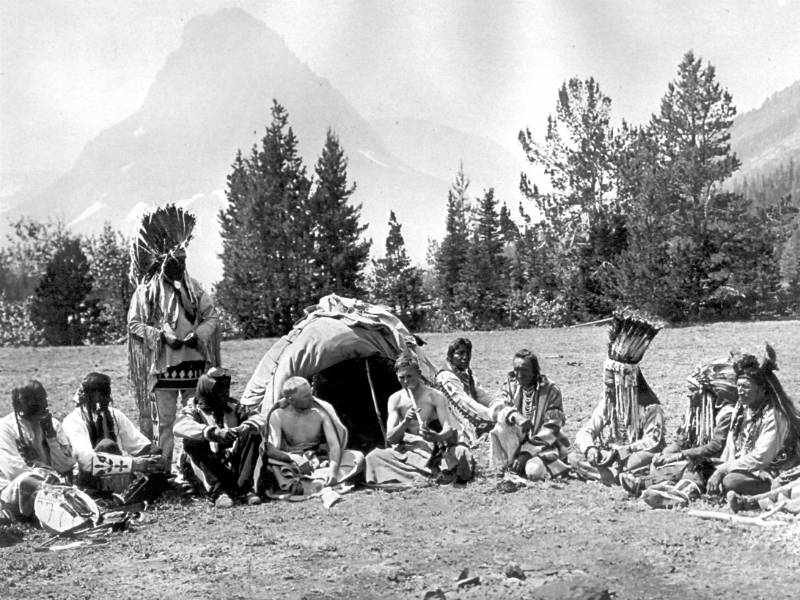 American writer Harry Behn smokes a ceremonial pipe, a common ritual within Native American culture.
Other death rituals include painting a dead person's face up red, the colour of life, or washing the body with yucca before burying. Sometimes feathers are tied around the caput of the dead tribe member as a form of prayer. Other common rituals such every bit smudging (the called-for of special herbs such equally sage) and smoking a special ceremonial pipe may be incorporated into funeral rituals, led by the tribe's medicine human or spiritual leader.
Some Native American tribes were somewhat fearful of the expressionless and many of their funeral rituals reflected this. Some would burn downward the home and possessions of the person who had died so that their spirit could not render.
Others, such equally the Navajo, would refuse to apply the name of the person for at to the lowest degree a year subsequently their death, in the belief that it would call back their spirit from the afterlife. The Navajo also believed that sudden and fierce deaths could cause bad spirits, or Chindi, to haunt the bereaved family. In this case, rituals were especially of import.
The Seminole tribe would place the body in a small-scale open-sided building chosen a chickee, and so relocate their entire settlement to motility abroad from it. They would as well sometimes take all of the possessions of the person who died and throw them into a swamp.
 Totem poles are symbolic carvings, sometimes used as memorials for important members of the tribe.
In some rare instances, tribes would construct a special kind of totem pole to commemorate the expressionless. Totem poles are vertical wooden carvings showing symbolic figures from legends, family histories or spiritual behavior, with a broad diverseness of purposes. The mortuary pole is an uncommon type of totem pole, sometimes used past the Haida and Tlingit for important members of tribe. The ashes or torso of the person who has died is placed within the pole, making a very prominent memorial.
The arrival of Christianity
When settlers from Europe began colonising America in the 15th and 16th Centuries, they brought with them Christianity. Their inflow signified a monumental modify for Native American culture, resulting in the eventual destruction of hundreds of tribes and ancient traditions.
 'Treaty of Penn with Indians' by Benjamin West. The colonisation of Due north America forever changed Native American culture.
Christian missionaries tried to catechumen tribes, with varied success. In 1882 the US Federal Regime tried to ban Native American rituals, calling them "repugnant to common decency and morality". Some tribes continued practising their ancient beliefs, but many were lost along the fashion.
From the 19th Century onwards, some Native Americans began to identify as Christian, but combined this new organized religion with traditional customs. Tribes who converted to Catholicism historic All Souls' Solar day on 1st Nov, commemorating the expressionless. Related to the Mexican festival of Dia de los Muertos, on this twenty-four hours Native Americans would exit food offerings and decorate their homes with ears of corn.
Today Native Americans may still honour the traditional customs of their tribe, with or without elements of Christianity and other religions. Their spirituality remains a complex, multi-faceted conventionalities organisation, with many varied funeral community to honour the expressionless.
45,139 verified reviews
Source: https://www.funeralguide.co.uk/blog/death-around-world-native-american-beliefs
0 Response to "Why Did the Indians Bury a Baby Upside Down"
Post a Comment