what does a monopoly do to an industry
10.1 The Nature of Monopoly
Learning Objectives
- Define monopoly and the human relationship between price setting and monopoly power.
- Listing and explain the sources of monopoly power and how they tin modify over time.
- Ascertain what is meant past a natural monopoly.
Monopoly is at the opposite cease of the spectrum of market models from perfect competition. A monopoly business firm has no rivals. It is the only firm in its industry. There are no shut substitutes for the good or service a monopoly produces. Not simply does a monopoly firm take the marketplace to itself, only information technology too demand not worry about other firms entering. In the instance of monopoly, entry by potential rivals is prohibitively difficult.
A monopoly does non take the market cost as given; it determines its own cost. Information technology selects from its demand curve the price that corresponds to the quantity the firm has called to produce in order to earn the maximum turn a profit possible. The entry of new firms, which eliminates turn a profit in the long run in a competitive market, cannot occur in the monopoly model.
A business firm that sets or picks price based on its output decision is chosen a price setter. A business firm that acts every bit a price setter possesses monopoly power. Nosotros shall encounter in the next affiliate that monopolies are not the only firms that take this power; nevertheless, the absence of rivals in monopoly gives it much more price-setting power.
As was the case when we discussed perfect competition in the previous chapter, the assumptions of the monopoly model are rather potent. In bold at that place is one firm in a market, we presume there are no other firms producing goods or services that could be considered part of the same market every bit that of the monopoly firm. In assuming blocked entry, we assume, for reasons we will talk over below, that no other firm can enter that marketplace. Such conditions are rare in the existent world. As always with models, nosotros make the assumptions that define monopoly in society to simplify our analysis, not to draw the real earth. The result is a model that gives us important insights into the nature of the choices of firms and their touch on the economy.
Sources of Monopoly Power
Why are some markets dominated by single firms? What are the sources of monopoly ability? Economists have identified a number of conditions that, individually or in combination, can lead to domination of a marketplace by a single firm and create barriers that prevent the entry of new firms.
Barriers to entry are characteristics of a detail market that block new firms from entering it. They include economies of scale, special advantages of location, high sunk costs, a dominant position in the buying of some of the inputs required to produce the expert, and government restrictions. These barriers may be interrelated, making entry that much more formidable. Although these barriers might permit ane firm to proceeds and hold monopoly control over a market place, there are often forces at work that can erode this control.
Economies of Scale
Calibration economies and diseconomies ascertain the shape of a firm's long-run average price (LRAC) bend as information technology increases its output. If long-run average cost declines equally the level of product increases, a firm is said to experience economies of scale.
A house that confronts economies of scale over the entire range of outputs demanded in its industry is a natural monopoly. Utilities that distribute electricity, h2o, and natural gas to some markets are examples. In a natural monopoly, the LRAC of any 1 house intersects the market need bend where long-run boilerplate costs are falling or are at a minimum. If this is the case, 1 business firm in the industry volition expand to exploit the economies of calibration available to it. Because this firm will have lower unit of measurement costs than its rivals, information technology can drive them out of the market and proceeds monopoly control over the industry.
Suppose at that place are 12 firms, each operating at the scale shown by ATC 1 (boilerplate total cost) in Figure ten.1 "Economies of Scale Lead to Natural Monopoly". A firm that expanded its calibration of operation to achieve an boilerplate total toll curve such as ATC 2 could produce 240 units of output at a lower cost than could the smaller firms producing twenty units each. By cutting its toll below the minimum boilerplate full price of the smaller plants, the larger firm could drive the smaller ones out of business. In this situation, the industry demand is not large enough to back up more one business firm. If another house attempted to enter the industry, the natural monopolist would always be able to undersell it.
Figure 10.1 Economies of Calibration Atomic number 82 to Natural Monopoly
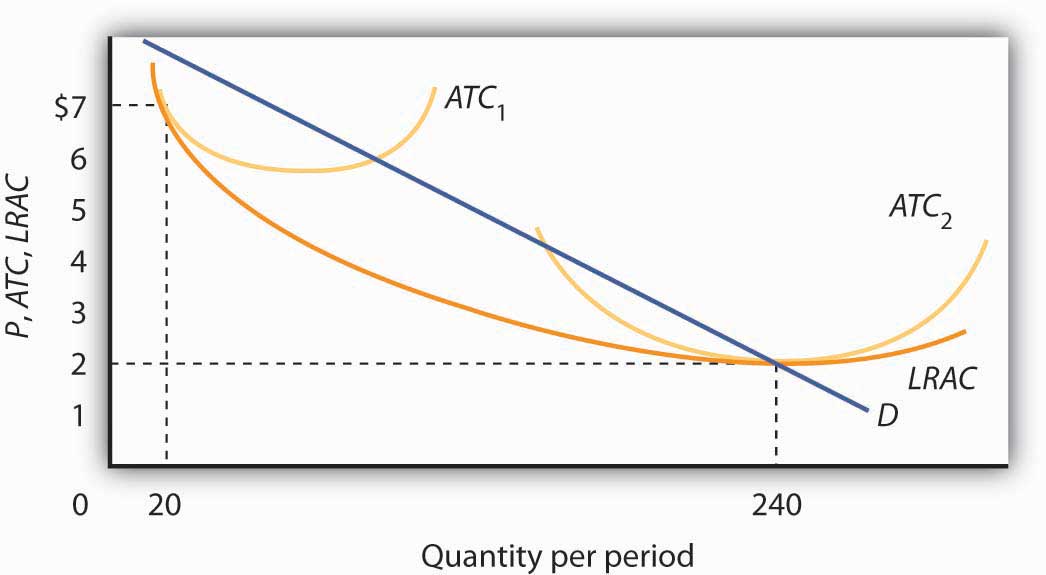
A firm with falling LRAC throughout the range of outputs relevant to existing demand (D) will monopolize the industry. Here, one firm operating with a big institute (ATC 2) produces 240 units of output at a lower cost than the $vii cost per unit of measurement of the 12 firms operating at a smaller scale (ATC 1), and producing 20 units of output each.
Location
Sometimes monopoly power is the effect of location. For example, sellers in markets isolated by distance from their nearest rivals accept a degree of monopoly power. The local movie theater in a small town has a monopoly in showing showtime-run movies. Doctors, dentists, and mechanics in isolated towns may besides be monopolists.
Sunk Costs
The greater the cost of establishing a new business in an industry, the more hard it is to enter that manufacture. That cost will, in turn, exist greater if the outlays required to first a business are unlikely to be recovered if the business concern should fail.
Suppose, for instance, that entry into a particular industry requires extensive advertising to make consumers aware of the new brand. Should the endeavour fail, there is no mode to recover the expenditures for such advertising. An expenditure that has already been made and that cannot exist recovered is called a sunk toll.
If a substantial fraction of a firm'due south initial outlays will be lost upon get out from the industry, exit will be plush. Difficulty of exit can make for difficulty of entry. The more than firms accept to lose from an unsuccessful try to penetrate a particular market, the less likely they are to endeavour. The potential for high sunk costs could thus contribute to the monopoly power of an established firm by making entry by other firms more difficult.
Restricted Buying of Raw Materials and Inputs
In very few cases the source of monopoly power is the ownership of strategic inputs. If a particular firm owns all of an input required for the production of a particular skillful or service, then it could emerge as the only producer of that adept or service.
The Aluminum Company of America (ALCOA) gained monopoly ability through its ownership of virtually all the bauxite mines in the world (bauxite is the source of aluminum). The International Nickel Company of Canada at one time endemic virtually all the world'southward nickel. De Beers acquired rights to about all the world's diamond production, giving information technology enormous ability in the market for diamonds. With new diamond supplies in Canada, Australia, and Russia being developed and sold independently of DeBeers, however, this ability has declined, and today DeBeers controls a essentially smaller percentage of the world'southward supply.
Government Restrictions
Some other important ground for monopoly power consists of special privileges granted to some business organization firms by government agencies. Land and local governments have commonly assigned exclusive franchises—rights to conduct business in a specific market—to taxi and double-decker companies, to cable goggle box companies, and to providers of telephone services, electricity, natural gas, and water, although the trend in recent years has been to encourage competition for many of these services. Governments might also regulate entry into an manufacture or a profession through licensing and certification requirements. Governments also provide patent protection to inventors of new products or production methods in order to encourage innovation; these patents may afford their holders a degree of monopoly power during the 17-year life of the patent.
Patents can accept on extra importance when network furnishings are nowadays. Network effects arise in situations where products become more useful the larger the number of users of the product. For example, one advantage of using the Windows calculator operating system is that so many other people employ it. That has advantages in terms of sharing files and other information.
Primal Takeaways
- An industry with a single firm, in which entry is blocked, is called a monopoly.
- A business firm that sets or picks price depending on its output determination is chosen a price setter. A price setter possesses monopoly power.
- The sources of monopoly power include economies of scale, locational advantages, loftier sunk costs associated with entry, restricted ownership of cardinal inputs, and government restrictions, such as exclusive franchises, licensing and certification requirements, and patents.
- A firm that confronts economies of scale over the entire range of output demanded in an industry is a natural monopoly.
Try Information technology!
What is the source of monopoly power—if any—in each of the following situations?
- The U.S. Food and Drug Assistants granted Burroughs Wellcome sectional rights until 2005 to manufacture and distribute AZT, a drug used in the treatment of AIDS.
- John and Mary Doe run the only shoe repair store in town.
- One utility visitor distributes residential electricity in your town.
- The widespread use of automatic teller machines (ATMs) has proven a benefaction to Diebold, the principal manufacturer of the machines.
Case in Point: The Administrator Bridge Fights to Maintain Its Monopoly
Effigy 10.2
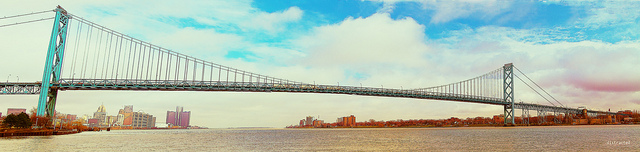
Matty Moroun was quietly enjoying his monopoly power. He is the owner of the 75-twelvemonth-erstwhile Ambassador Bridge, a intermission bridge that is the simply connexion between Detroit, Michigan and Windsor, Ontario. He purchased the bridge from Warren Buffet in 1974 for $thirty million. Forbes estimates that it is worth more than $500 million today. Mr. Moroun now oversees the artery over which $100 billion of goods—ane quarter of U.S. trade with Canada and 40% of all truck shipments from the U.S.—make their way between the two countries.
Despite complaints of high and rise tolls—he has more than doubled fares for cars and tripled fares for trucks—Mr. Moroun has so far held on. Kenneth Davies, a lawyer who often battles Mr. Moroun in court, is a grudging admirer. "He's very intelligent and very aggressive. His avarice and greed are only American commercialism at work," he told Forbes.
What are the sources of his monopoly ability? With the closest alternative bridge across the Detroit River two hours away, location is a big plus. In add-on, the cost of creating a new transportation link is loftier. A group that is because converting an old train tunnel to truck use and boring a new railroad train tunnel some altitude abroad is facing a $600 meg price tag for the project. In addition to having entry by potential competitors blocked , he has a status not shared by nigh other monopolists. The Michigan Supreme Court ruled in 2008 that the urban center of Detroit cannot regulate his business because of the span's international nature. Canadian courts have barred whatever try by Canadian authorities to regulate him. He will not even allow inspectors from the government of the Us to set foot on his span.
Increased security since nine/11 has caused delays, but Mr. Moroun has eased these by increasing his own spending on security to $l,000 a week and by building additional inspection stations and gifting them to the U.S. inspection bureau, the General Services Administration. Fifty-fifty a monopolist understands the importance of keeping his customers content!
Considering of the terrorist attacks on 9/xi and the concern most vulnerability and security, calls to deal with this monopoly take increased. Some people argue that the authorities should buy what is the about important single international arterial in N America, while others take called for more regulatory oversight. Canadian groups are exploring the evolution of culling means of bringing traffic between the United States and Canada. Fourth dimension volition tell whether Mr. Moroun tin can hold onto what Forbes writers Stephane Fitch and Joann Muller dubbed "the all-time monopoly yous never heard of."
Sources: Stephane Fitch and Joann Muller, "The Troll Under the Bridge," Forbes 174:10 (November 15 2004): 134–139; John Gallagher, "Program Uses Parkway to Ease Ambassador Bridge Traffic," Detroit Gratuitous Press, May i, 2008; and "State Supreme Courtroom Sides with Administrator Bridge in Dispute," Detroit News, May 7, 2008.
Answers to Try It! Issues
- The government'south grant of an exclusive franchise to the drug gave the business firm monopoly power.
- While John and Mary have the simply store in town, this is an easy entry concern. Farther, there may be competitors in the nearby boondocks. John and Mary probably have monopoly power, only they do not have a monopoly.
- Natural monopoly
- Patent with potent network effects
Source: https://open.lib.umn.edu/principleseconomics/chapter/10-1-the-nature-of-monopoly/
0 Response to "what does a monopoly do to an industry"
Post a Comment